Add a 2.2 inch ili9341 spi display


Info
It’s a little bit tricky get those displays running under piCorePlayer. Other spi displays like Waveshare or Spotpear, that are fitted with the same ili9341 chip, may work too with this overlay. I tested it with Spotpear 2.4 inch spi LCD.
Add a 3.5 inch display
Warning
If upgrading from pCP version 9.2 or lower, or if installing fresh on pCP 10 or higher, be sure to read the important note below, otherwise jivelite will fail to write out its settings.
Add a 4.3 inch Waveshare DSI Display, Touch, 800x480


Info
This is one of the easiest ways to get a touch display running under pCP. It may run in same way with bigger DSI-Displays, same resolution, but it isn’t tested yet.
Add a 4 inch Waveshare display spi touch
Steps
Step 1 - Connect the display to your Raspberry PI
- Plug the display directly on the GPIO pins of your RPi and connect the HDMI plug with an HDMI-adaptor.

Add a 5 inch Waveshare display spi touch
What we need
- Raspberry Pi 2, 3, 4 or piZero WH
- 8GB Micro SD card
- Waveshare 5 inch display, resistive spi-touch with HDMI-adaptor
- Optional: Some jumper wires, female to female
- Powersupply, 5V, >= 2,5 A
- PC or Laptop, Putty installed
Preparation
- Plug the display directly on the GPIO pins of your PI and connect the HDMI plug with an HDMI-adaptor
Add a 5.5 inch Waveshare AMOLED display
More information
- Waveshare 5.5 inch Touch AMOLED Display
- Download piCorePlayer
- Burn piCorePlayer onto a SD card
- Determine your piCorePlayer IP address
- Access piCorePlayer via ssh
- Edit config.txt
- piCorePlayer aliases
- piCorePlayer CLI
- Basic vi commands
- Raspberry Pi config.cfg
- Waveshare 4.1 TFT + piCorePlayer + Jivelite
- Documentation / fb / fbcon.txt
Add a 7.9 inch Waveshare display
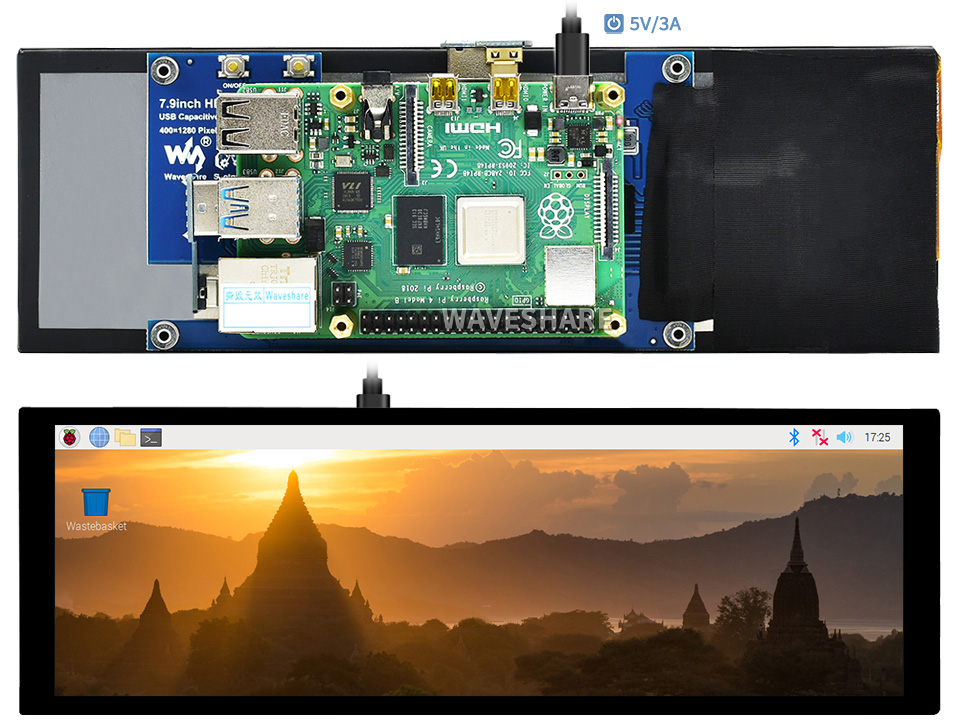
Steps
Step 1 - Prepare SD card
- Put a fresh pCP image on to the SD card—see Burn piCorePlayer onto a SD card.
- While the SD card is still in the laptop/pc:
- Enter wifi credentials in wpa_supplicant.conf.sample and “save as” wpa_supplicant.conf.
- Add the following lines to config.txt, in the Custom Configuration area at the end of the file (between the Begin-Custom and End-Custom lines).
#---Begin-Custom-(Do not alter Begin or End Tags)-----
gpu_mem=128
disable_splash=1
avoid_warnings=2
hdmi_group=2
hdmi_mode=87
hdmi_timings=400 0 100 10 140 1280 10 20 20 2 0 0 0 60 0 43000000 3
display_rotate=3 #270 degrees
#---End-Custom------------------------
Info
You find these two files in your Windows Explorer in root-section of the pcp_boot drive.
Add an IR receiver to piCorePlayer


- Today nearly every device is fitted with an IR remote, so why not a piCorePlayer?
- If your display has no touch or you do not want to control your device by a smartphone, an IR remote is very helpful.
What we need
- Raspberry Pi
- piCorePlayer 8 with Jivelite installed
- A running display connected to RPi
- An TSOP4838 or similar IR receiver like OS-0038N
- 3 jumper wires, female to bare wire
- Soldering iron, solder, some heat shrink tube
- A JustBoom IR remote
Info
TSOP4838 IR receivers are sold in differing designs!
Create a custom kernel IR keytable
- Today nearly every device is fitted with an IR remote, so why not piCorePlayer?
- If your display has no touch capability or you do not want to control your device by a smartphone, an IR remote can be very helpful.
- Since 4.19 linux kernel the original LIRC uinput drivers have been removed.
- We need to configure IR keytables to get IR remotes running with pCP.
- We use a cheap NEC Remote.

Add a Topping E30 USB DAC

What was used
Hardware
- Raspberry Pi 4B - 1GB.
- Raspberry Pi 15.3W USB-C Power Supply.
- SanDisk Ultra 8GB SD card—see SD card.
- Topping E30 USB DAC—see Topping E30 II.
Warning
The Topping E30 USB DAC is no longer available. The Topping E30 II is the later equivalent.